Original explanatory graphic: Teamster Taxi editorial. Source context is linked below.
Read the diagram in words
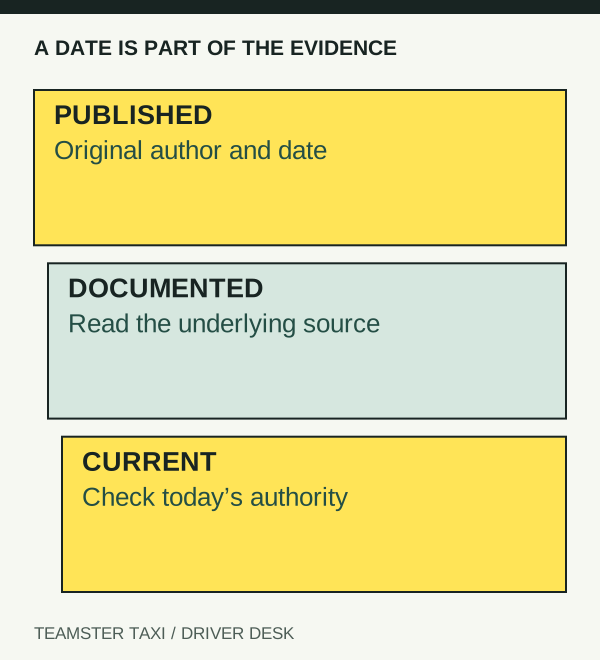
Read in three steps: original date and author; the document or evidence behind the notice; the current organisation responsible for today’s question.
First, identify the kind of record
A newsletter, meeting notice, opinion piece, court report and application form do different jobs. A news report that a bill passed one chamber is not the same as the enacted law. A proposal, draft and signed document should not be read as interchangeable stages.
The news archive keeps the original publication date and byline. The Fare Times shelf links complete documents when available. Read the document itself when a headline or short notice cannot answer your question.
Keep three dates apart
- Publication date: when the author published the notice.
- Event or effective date: when the described meeting, change or arrangement concerned its audience.
- Archive capture date: when a web archive saved the page.
An archive capture in 2019 does not turn a May 2015 report into a new event. A document checked in 2026 does not acquire a 2026 original publication date.
Use a worked example
A January 2014 Fare Times notice links a two-page newsletter. Read the notice for the original context and the PDF for its detailed record. If your question concerns licensing now, follow the current City or County route rather than using a 2014 fee, meeting time or staff extension.
Pandemic guidance needs a clear boundary
The April 2020 unemployment notice addressed emergency pandemic programmes. Washington ESD now states that the pandemic programmes have expired and new pandemic-related claims are not being backdated. That historic notice is not a current application procedure or benefit promise. Use ESD’s present service for an individual question.
Keep a small source ledger
For a useful note, record the title, author, original date, document title and the exact question it answers. Then add the present official source for any current action. If a video is only linked, do not claim that the video file itself is available in the document library.
The result is a traceable comparison rather than a new claim made by an old author. Historical contributors are credited for their original work; today’s driver guides are separate editorial explanations.
Primary sources
Worked source check: a signed wheelchair-accessibility rule
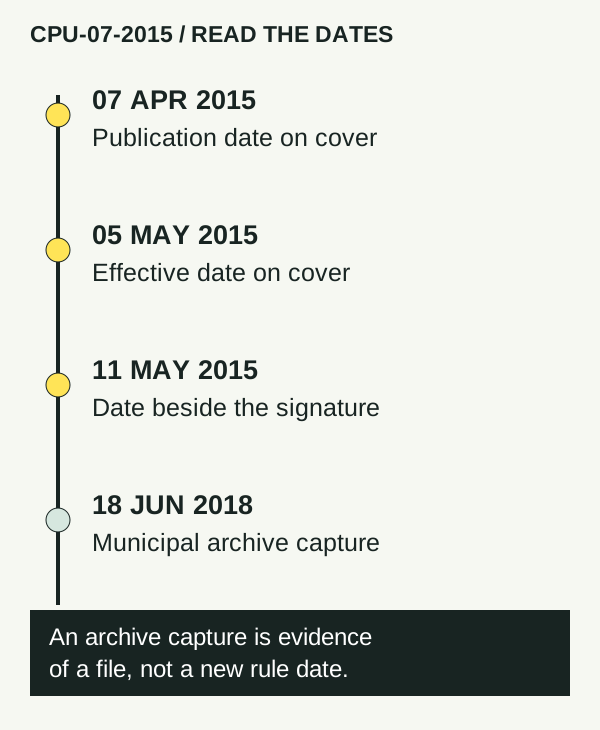
The complete six-page CPU-07-2015 original includes a signed cover and the rule text. Three dates are printed on that cover: publication 7 April 2015, effective 5 May 2015 and signature 11 May 2015. Keep those distinct even though they are not in the same chronological order on the page.
Original explanatory graphic: Teamster Taxi editorial. Source: the linked City of Seattle original. The diagram is a conceptual reading aid.
Read the four dates in words
The signed CPU-07-2015 cover has publication 7 April 2015, effective 5 May 2015 and signature 11 May 2015; its municipal capture is 18 June 2018.
A repeatable reading procedure
- Open the cover and record the rule number and each labelled date. Do not replace a printed date with the PDF’s technical creation date.
- Check that the full file is present: the cover says “1 of 6”, and the final page contains the reimbursement summary.
- Follow the category through the text: driver expenses, owner expenses and reimbursement transparency are different sections.
- For a question about present eligibility, open Seattle’s current WAS Fund page. It identifies the joint City–County rule governing reimbursements; the 2015 amounts are not a current entitlement.
- Keep the original URL and the 18 June 2018 municipal capture alongside the notes. The capture records preservation, not a new effective date.
Fictional reading example: a driver sees a reimbursement amount in the 2015 summary and asks whether it is payable now. The appropriate record is “historical amount in CPU-07-2015, current eligibility not established”, followed by the current programme’s answer. Finding an old number does not establish that a new claim qualifies.
Worked map check: census tract, ZIP code and city limit
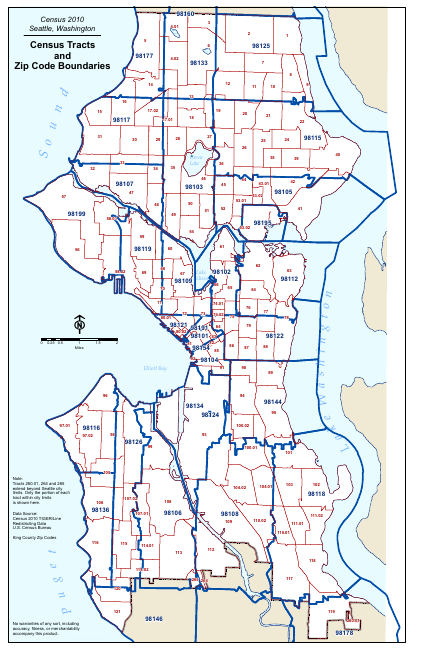
The original Seattle Census 2010 map overlays census tracts, ZIP code boundaries and the city limit. The PDF’s technical metadata dates from 2013; its municipal capture is 17 April 2015. Neither date changes the census year printed on the map.
Original explanatory graphic: Teamster Taxi editorial. Source: the linked City of Seattle original. The diagram is a conceptual reading aid.
Read the boundary key in words
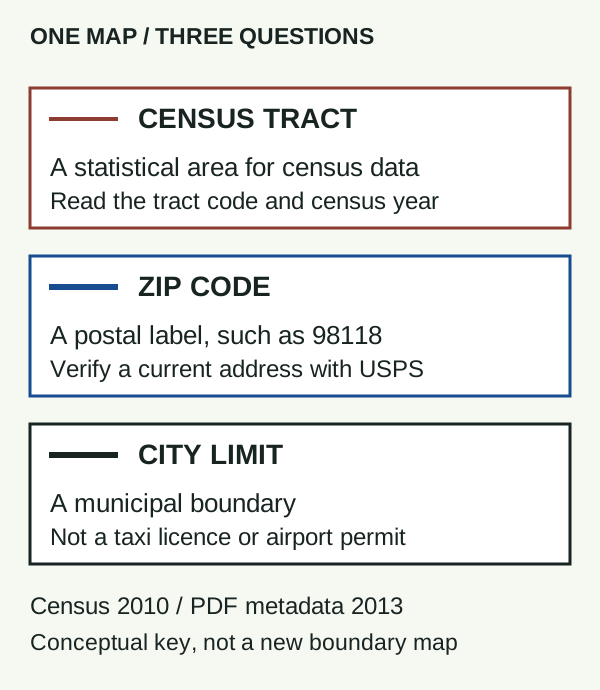
Census tracts describe statistical areas; ZIP codes identify postal areas; city limits describe the municipal boundary. The Census 2010 map is a historical reference.
Use the right layer for the question
- Read the title and legend before identifying a place. The thin tract divisions and the ZIP boundaries answer different questions.
- Check the label type. For example, 98118 is a five-digit ZIP label; 110.02 is a tract code. Do not enter a tract number where a postal code is required.
- For a current postal address, use the USPS ZIP Code lookup with the complete address. Do not infer the delivery ZIP from a neighbourhood name alone.
- For a taxi or airport operating question, use the relevant licensing or Port source. A map boundary does not grant an operating permission.
The map itself disclaims warranties of accuracy and fitness. Keep it with the historical source record; check current addresses and requirements at their responsible source.