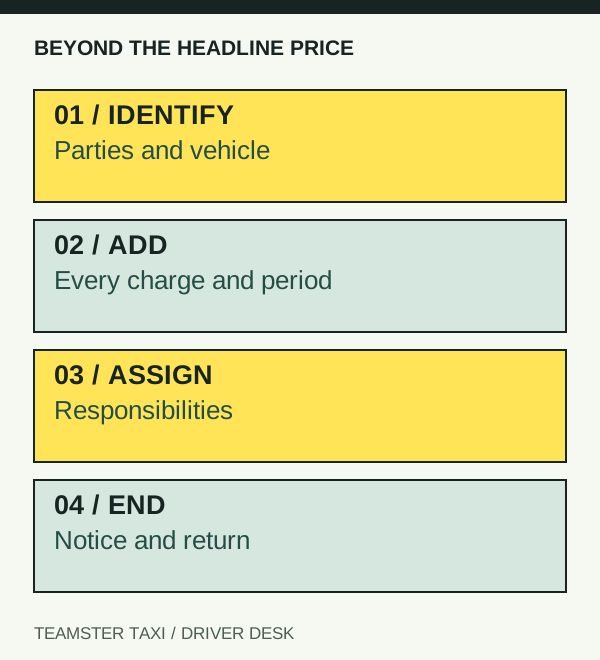
Original explanatory graphic: Teamster Taxi editorial. Source context is linked below.
Read the diagram in words
Read a lease in four passes: identify the vehicle and parties; list every charge; assign responsibilities; record how the arrangement ends.
Find the complete agreement
A spoken daily price is not the whole arrangement. Ask for the written agreement and the documents it incorporates. Record the parties, the exact vehicle and the dates. Check whether the proposal concerns a vehicle, a medallion interest or another arrangement; these descriptions should not be mixed casually.
Seattle’s owner guidance describes the vehicle lease summary route and a limited temporary-use arrangement with its own conditions. An informal label such as “occasional driver” does not establish that the exception applies. Ask the authority or a qualified adviser about your actual arrangement.
Make the price comparable
- Write the lease charge and its period: shift, day, week or another basis.
- List dispatch, payment-processing, equipment, cleaning and other charges separately. Ask which are fixed and which depend on use.
- Identify fuel or charging, tolls, parking and other operating costs that fall to the driver.
- Record the deposit, what can be deducted and how its return is documented.
- Ask who bears downtime, repair, insurance excess and substitute-vehicle costs. Do not fill an unanswered item with zero.
A fictional comparison
Offer A is $90 for a shift, plus a $15 dispatch charge and $5 equipment charge. Offer B is $105 including those two items. Before fuel and other costs, A totals $110 and B totals $105. This is arithmetic for an invented example, not a market quotation, a permitted price or a recommendation to accept either offer.
The comparison is incomplete until both offers cover the same shift length, vehicle access, mileage conditions, insurance position and responsibilities. A lower headline price can describe less service or more risk.
Read the end as carefully as the beginning
Find the termination conditions, notice procedure, outstanding charges, equipment return and deposit process. Ask how a disputed charge is recorded and who receives the question. Keep your copy of the complete signed documents and receipts. A photograph of one price line is not a substitute for the agreement.
Leave with a useful question list
- What exactly does this price include?
- Which charges can change, under which written provision?
- Who confirms that I am covered to drive this vehicle?
- What happens if the cab is unavailable or the agreement ends?
- Which summary or other filing is required for this arrangement?
Use the shift-cost calculator only after you have identified the inputs. It cannot decide whether a clause is lawful or an arrangement is suitable for you.
Primary sources
Read the complete 2014 lease rule in its period
The five-page Seattle R-6.310.315 vehicle lease rule carries a publication date of 16 October 2014 and an effective date of 12 November 2014. Its cover identifies the edition it superseded. Its prices, payment periods and surcharge provisions are historical evidence, not a quote for a lease today.
Use a three-column comparison
- Original rule: write its title, effective date and the numbered clause you are reading.
- Agreement in front of you: identify the same subject, such as the payment period, receipts, return or termination.
- Current authority: check the City’s current owner and lease guidance and record the rule or confirmation that actually applies to the proposed work.
For example, a historical per-shift cap cannot be compared with a present weekly offer by reading only the two headline amounts. First identify the period, what the agreement covers and the current rule. Leave any unresolved difference as a question for the responsible authority.
Open all five original pages · Municipal source capture, 16 December 2014. See how to distinguish rule dates from archive dates.